
Dubai has become one of the most fintech-friendly capitals in the world. But when Gulf-based payment apps, neobanks, remittance platforms and wealth products look east to India — a market of 1.4 billion people and the world’s largest real-time payments network — most of them stumble. Not because their product is weak, but because they market to India the way they market to the UAE. India rewards a completely different playbook.
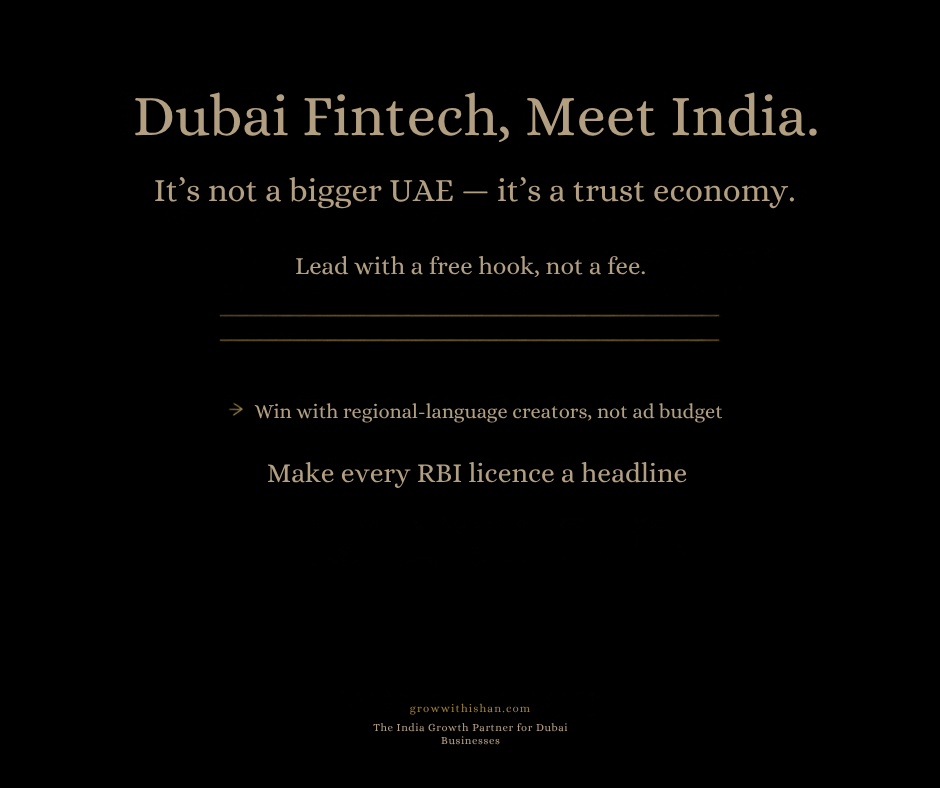
India Is Not a Bigger UAE — It’s a Trust Economy
In the Gulf, a sleek app and a good rate often close the deal. In India, financial trust is earned slowly and lost instantly. Indian consumers have lived through UPI, demonetisation, app-based lending scams and RBI crackdowns — so they scrutinise every money app for legitimacy signals before they part with a rupee. For a Dubai fintech, that means your India launch is not a performance-marketing problem first. It’s a credibility problem. Regulatory clarity, visible grievance-redress, real customer faces and recognisable local partnerships matter more than your CAC spreadsheet suggests.
Price Psychology and the Free-First Instinct
The Indian fintech user has been trained by Paytm, PhonePe and Google Pay to expect zero transaction fees, instant cashback and constant utility. A subscription or a per-transaction fee that feels reasonable in Dubai can quietly kill adoption in India. Winning brands lead with a free, high-frequency hook — a bill payment, a UPI feature, a savings nudge — and monetise later through lending, wealth or cross-border rails. If your first message to an Indian user is about price, you have already lost the tier-2 and tier-3 customer who makes up the real volume.
Distribution Beats Advertising in India
Dubai fintechs often arrive with a large paid-media budget and burn it on Meta and Google, competing against domestic giants who out-spend them ten to one. The unlock is distribution, not ad auctions: regional-language creators who explain your product in Tamil, Telugu, Marathi and Bengali; finance micro-influencers who carry genuine trust; PR that plants your name in credible Indian business media; and podcast appearances that let founders explain the “why” behind a foreign money app. This is exactly the corridor advantage I write about in why 2026 is the year Gulf businesses should enter India — the companies that win treat India as a distribution game, not a media-buying game.
Regulation Is a Marketing Asset, Not Just a Compliance Cost
The RBI environment scares many foreign fintechs. But the smart ones flip it: every licence, every partnership with a regulated Indian bank or NBFC, every data-localisation commitment becomes a trust story you tell loudly. Indian consumers actively look for “RBI-regulated,” “data stored in India,” and “backed by [known bank]” cues. What a Dubai founder sees as red tape, the Indian buyer reads as safety — so put it in your headline, not your footer.
The Operator’s Shortcut
You have Dubai’s capital. India has 1.4 billion customers and the appetite to adopt new money products faster than almost any market on earth. What’s usually missing is an operator who already understands Indian trust triggers, price psychology and the distribution machine that reaches beyond the metros. That’s the gap I close: connecting Gulf ambition to Indian scale, priced for a Dubai budget.
If you’re a Dubai fintech planning your India entry — or already spending and not seeing traction — let’s talk about the playbook that actually fits this market. Message me on WhatsApp: https://bit.ly/4511CQR
